
Table Of Contents
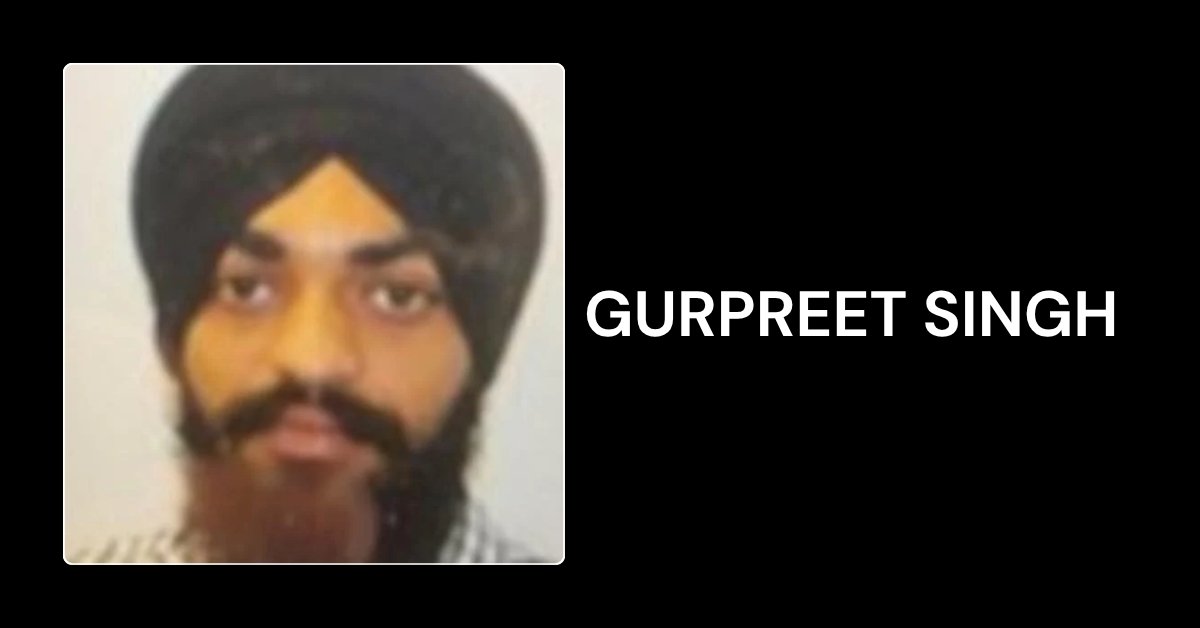
Gurpreet Singh
On 30 July 2026, the Federal Bureau of Investigation published a wanted notice for a man named Gurpreet Singh.
The notice appeared under the bureau’s Criminal Enterprise Investigations category, which is reserved for people the FBI believes are connected to organised criminal groups rather than to isolated offences.
The listing is short.
It runs to a photograph, a physical description, a date of birth, and a single paragraph of explanation.
However, that paragraph places Gurpreet Singh inside one of the largest transnational organised crime prosecutions the United States has ever brought against a network with roots in the Indian state of Punjab.
This dossier sets out what the official record says, what it does not say, and why the case matters well beyond the individual named in it.
A note before we begin.
Everything described here is an allegation.
A federal indictment is a formal accusation, not a finding of guilt.
Gurpreet Singh has not been convicted of anything described below, and under American law he is presumed innocent unless and until a court decides otherwise.
Dossier At A Glance
| Field | Detail |
|---|---|
| Name on record | Gurpreet Singh |
| Date of birth used | 2 October 1995 |
| Nationality | Indian |
| Sex | Male |
| Height | 5 feet 7 inches |
| Weight | 143 pounds (approximately 65 kg) |
| Hair | Black |
| Eyes | Brown |
| Photograph on file | Taken in 2025 |
| FBI category | Criminal Enterprise Investigations (CEI) |
| Investigating field office | Los Angeles |
| Arrest warrant issued | 25 June 2026 |
| Issuing court | United States District Court, Central District of California, Los Angeles |
| Alleged affiliation | Jaggu Bhagwanpuria Organized Crime Group |
| Wanted notice published | 30 July 2026 |
| Reward offered | None stated on the FBI notice |
The FBI notice does not list aliases, a last known address, a home village, or any known travel history. That absence is worth noting because it tells you something about the state of the investigation when the notice went public.
What The FBI Notice Actually Says
The wanted notice is precise in its wording, and the precision matters.
The FBI states that Gurpreet Singh is wanted for his alleged involvement in a transnational criminal organisation.
It describes that organisation as being engaged in four categories of conduct: racketeer-influenced and corrupt organisations conspiracy; conspiracy to engage in the business of dealing in firearms without a licence; conspiracy to distribute and possess with intent to distribute controlled substances; and distribution of controlled substances.
The organisation is named as the Jaggu Bhagwanpuria Organized Crime Group.
The FBI says it originated in the Punjab state of India and operated in the Central District of California and elsewhere.
The notice then narrows to Gurpreet Singh personally.
On 25 June 2026, a federal arrest warrant was issued for him after he was charged with two specific offences: conspiracy to distribute and possess with intent to distribute controlled substances, and distribution of controlled substances.
Read carefully; the structure is this.
The first list describes what the organisation is alleged to have done.
The second, shorter list describes what Gurpreet Singh himself is charged with.
The two are not identical, and conflating them is the single most common error in coverage of cases like this.
The Charges Explained In Plain Language
Federal charging language is dense. Here is what each term means in ordinary English.
| Charge | What It means |
|---|---|
| Conspiracy to distribute and possess with intent to distribute controlled substances | An agreement between two or more people to supply illegal drugs, or to hold them for the purpose of supplying them. The agreement itself is the crime. Prosecutors do not need to prove the drugs were ever actually sold. |
| Distribution of controlled substances | The actual transfer of illegal drugs to another person. This does not require money to change hands. |
| RICO conspiracy | RICO stands for Racketeer Influenced and Corrupt Organizations. It is a law from 1970 that allows prosecutors to charge an entire criminal group as a single enterprise, rather than pursuing each offence separately. It was written to attack the mafia and is now used against gangs and cartels worldwide. |
| Conspiracy to deal in firearms without a licence | An agreement to run a gun-selling business without the federal licence that United States law requires for anyone in the trade. |
The two charges filed against Gurpreet Singh carry serious weight in the American federal system.
The Justice Department has stated that many defendants in this group of cases face a mandatory minimum sentence of between ten years and life in federal prison, with a statutory maximum of life imprisonment, if convicted.
Operation Hard Ball: The Wider Case
The warrant for Gurpreet Singh did not appear on its own. It belongs to a much larger federal action.
On 7 July 2026, the United States Attorney’s Office for the Central District of California announced the results of a years-long investigation it called Operation Hard Ball.
The operation targeted three separate India-based transnational organised crime groups.
Here is the shape of that operation.
| Metric | Figure |
|---|---|
| Total defendants charged | 37 |
| Indictments unsealed | 3 |
| Defendants arrested | 24 |
| Arrests in California | 11 |
| Other United States arrests | Indiana (1), Georgia (1) |
| Arrests in Canada | 3 |
| Arrests in Spain | 1 |
| Already in custody before the sweep | 7 |
| Fugitives still sought | 10 (7 in the United States, 2 in India, 1 in Europe) |
| Cocaine seized | Approximately 1,000 kg |
| Heroin seized | Approximately 1 kg |
| Cash seized | Approximately 40,000 US dollars |
| Firearms seized | A dozen |
| Search warrants executed | 23 in the Sacramento area, 11 in the Los Angeles area |
The three indictments were filed against three distinct networks.
The first targeted the enterprise associated with Lawrence Bishnoi.
The second targeted the enterprise associated with Jaggu Bhagwanpuria.
The third targeted a cocaine and methamphetamine smuggling network associated with Ravinder Singh Dhanda of Vancouver.
Gurpreet Singh falls within the second of those three.
The Bhagwanpuria indictment was returned by a federal grand jury on 25 June 2026, the same date as his arrest warrant, and charges 17 defendants across seven counts.
The investigation was led by the FBI and the Los Angeles Police Department alongside the Royal Canadian Mounted Police and United States Customs and Border Protection.
Support came from Spain’s Guardia Civil, Homeland Security Investigations, the Drug Enforcement Administration, and FBI legal attaché offices in New Delhi, Ottawa, Madrid, and Mexico City.
That list of partners is itself a useful measure of how far the alleged network was thought to reach.
The Bhagwanpuria Network: What Prosecutors Allege
The Justice Department describes the Bhagwanpuria group as a transnational criminal syndicate headquartered in India, with members and associates in the United States, Canada, the United Kingdom, Europe, Australia, and New Zealand.
Prosecutors put the size of the network at more than 1,000 members and associates worldwide, including more than 100 in the United States alone.
The alleged conduct described in the indictment falls into several strands.
Narcotics
Prosecutors allege the group funded itself through drug trafficking, including transport sub-networks operating in Los Angeles and the Inland Empire.
Reporting on the indictment describes regional crews collecting narcotics in Southern California and loading them onto long-haul semi-trucks bound for the eastern United States and the Canadian border, with a standard shipment said to contain 100 kilograms or more of cocaine or methamphetamine.
Corruption Of Officials In India
This is perhaps the most striking allegation.
Prosecutors say the group cultivated corrupt law enforcement officers and government officials in India, and fed them false information about crimes.
That false information was allegedly used to trigger baseless criminal proceedings against rivals and against people suspected of cooperating with police, which in turn opened the door to extortion.
The indictment gives one example.
In April 2026, a 22-year-old member named Gurlal Singh, based in Stockton, California, is alleged to have threatened a victim and then passed the victim’s name to a corrupt officer in Punjab.
According to the charging documents, this led to the victim, the victim’s father, and the victim’s sister being falsely accused of a murder committed in India in January 2026.
Extortion
A separate defendant, Gurdev Singh, is alleged to have attempted to extort a family living in Ohio while he was himself being held in immigration custody.
Recruitment
Court filings reported by news agencies allege the organisation deliberately recruited vulnerable young people in Punjab, promising money, status, and a route to migrate abroad.
The filings are said to allege that the group targeted minors because they faced lighter penalties if caught, and that in some cases recruits were paid as little as 20,000 rupees, roughly 200 US dollars, to carry out killings.
Prosecutors further allege that leaving the organisation was extremely difficult, and that members considered disloyal risked violent retaliation against themselves or against relatives still living in India.
Who Is Jaggu Bhagwanpuria?
The organisation carries his name, so the man behind it is worth understanding.
| Field | Detail |
|---|---|
| Given name | Jagdeep Singh |
| Known as | Jaggu Bhagwanpuria |
| Age (2026) | 38 |
| Origin | Bhagwanpur village, Gurdaspur district, Punjab, India |
| Status | Imprisoned in India |
| Relationship to Lawrence Bishnoi | Former associate, later rival |
Jaggu Bhagwanpuria is not a new name in India.
Punjabi press has tracked him for well over a decade, and Indian police have linked him to a very large number of registered cases spanning narcotics, extortion, weapons offences, and murder.
He has been in custody in India since the middle of the last decade and has been moved between prisons in different states.
The core allegation in the American indictment is that imprisonment did not stop him.
Prosecutors say he continued directing international operations from inside jail, using contraband mobile phones and internet-based communication devices to oversee drug trafficking, extortion, and violence carried out by associates overseas.
Bhagwanpuria was once associated with Lawrence Bishnoi, the far better-known jailed gangster whose enterprise was designated a terrorist entity by the Canadian government in September 2025.
The two men split, and their groups became rivals.
Operation Hard Ball charged both networks at the same time, which is unusual and suggests investigators saw the two as parts of a single ecosystem rather than as unrelated targets.
The violence has reached the family level.
In June 2025, Bhagwanpuria’s mother, Harjit Kaur, a former elected member of her village panchayat, was shot near her residence in Batala along with a close associate.
Both died.
A rival group publicly claimed responsibility.
An Important Note On The Name
There is a genuine identification problem embedded in this case, and any responsible dossier has to state it plainly.
Gurpreet Singh is one of the most common names in Punjab and across the global Sikh diaspora.
There are many thousands of men named Gurpreet Singh living entirely ordinary lives in India, Canada, the United Kingdom, the United States, Australia, and elsewhere.
There are also several unrelated criminal cases in different countries involving people who share the name.
The FBI notice is therefore not identifying a name.
It is identifying a specific individual, tied to a specific photograph taken in 2025, a specific date of birth of 2 October 1995, and a specific set of physical measurements.
Anyone reading about this case should treat the photograph and the date of birth as the identifying features, not the name.
Assuming that a person named Gurpreet Singh is connected to this matter based on the name alone would be both wrong and unfair.
Indian outlets that covered the listing at the end of July 2026 described the man as a Punjab resident.
The FBI notice itself states only that his nationality is Indian.
What Typically Happens Next In A Case Like This
Because this dossier is written to remain useful over time, it is worth setting out the general path such cases follow rather than speculating about outcomes.
Location And Arrest
A fugitive on an FBI wanted notice may be arrested inside the United States by federal or local officers, or detained abroad by a partner agency.
Several defendants in Operation Hard Ball were located outside American territory, in Canada and in Spain.
Extradition
If a defendant is found in another country, the United States must request extradition through that country’s legal system.
This process can take months or years, and it can fail.
India and the United States have an extradition treaty dating from 1997, though extraditions between the two countries have historically been slow and relatively rare.
Initial Appearance And Detention
Once in American custody, a defendant appears before a federal magistrate judge, is formally advised of the charges, and either is released on conditions or held pending trial.
In organised crime cases, prosecutors routinely argue for detention on flight risk grounds.
Trial Or Plea
The large majority of federal cases in the United States resolve through plea agreements rather than trial. Multi-defendant RICO cases frequently take years to resolve, and defendants are often severed into smaller groups.
Removal Of The Notice
The FBI removes a wanted notice from its public site once a fugitive is in custody or the matter is otherwise resolved.
If the notice for Gurpreet Singh is no longer live when you read this, that is the most likely explanation, though it is not the only one.
Readers wanting the current status of any individual defendant should consult the federal court docket for the Central District of California rather than relying on news coverage, which tends to report the charging of a case far more loudly than its resolution.
Why This Case Matters
It would be easy to file this away as one more drug prosecution.
It is more interesting than that, for three reasons.
It Treats A Diaspora Crime Problem As A Single System
For years, gang violence linked to Punjab has been discussed as an Indian domestic issue that occasionally spills into Canadian or American suburbs.
Operation Hard Ball treats the whole thing as one connected enterprise, running from prison cells in India through recruitment pipelines, migration routes, drug corridors in Southern California, and extortion targeting families in Ohio and Los Angeles.
It Puts Alleged Police Corruption In India Into An American Indictment
The allegation that a criminal group weaponised corrupt officers in Punjab to fabricate cases against rivals is not a marginal detail.
It is a claim that the machinery of a foreign justice system was allegedly rented out as an instrument of extortion.
That is a serious statement to make in a federal charging document.
It Shows How Prison Walls Have Become Porous
The central premise of the Bhagwanpuria and Bishnoi indictments is that both alleged leaders ran global operations while locked up, using smuggled phones.
Incarceration, on this account, changed the logistics of the enterprise without ending it.
For the Indian diaspora specifically, the case carries a heavier weight.
The Justice Department was explicit that the harm from these networks is felt most sharply within diaspora communities, through extortion demands made to families with relatives still living in India, where retaliation is easier to arrange.
Trivia
The name that appears on the indictment, Bhagwanpuria, is not a surname. It is a place. Jagdeep Singh was born in the village of Bhagwanpur in Gurdaspur district, Punjab, and adopted the village name as part of his alias after entering the criminal world. The convention is common in Punjab’s gang culture, where operators are known by their home village rather than by family name, partly because surnames such as Singh are shared so widely that they carry almost no identifying power. There is an odd consequence to this.
The United States Department of Justice, in the formal caption of a federal racketeering indictment filed in Los Angeles, is effectively naming the case after a small farming village near Batala with a population in the low thousands.
Before any of that, according to Punjabi press accounts, Jagdeep Singh was known locally for something entirely different. He was a kabaddi player.
Author